


Growl
Introduction
Growl is a legendary season KvK-limited Tower of Knowledge skill built around a simple tradeoff: early tempo in exchange for raw damage scaling. On paper, a 50% increase to physical damage suggests a top-tier offensive option. In practice, its value depends heavily on how your build generates damage and how combat unfolds over time.

Unlike skills that enable more frequent attacks or trigger chains, Growl operates as a pure amplifier. It strengthens what your build already does, but does not help it do it more often. That distinction defines where the skill performs well—and where it falls short.
Skill Description
Growl: Lowers your initial Energy by 100, and increases your Physical Damage by 50%

Mechanics and Tradeoffs
Growl combines a very large offensive modifier with a meaningful tempo penalty. Understanding how these two parts interact is key to evaluating the skill.
The 50% physical damage increase applies broadly across a physical damage build. It enhances normal attacks, physical skill damage, and any effects that scale from physical output.
The energy penalty introduces a more subtle limitation. Starting with 100 less energy delays the first ultimate cast, which can have a real impact in faster fights—especially in PvP, where early ultimates often decide momentum. In slower encounters, this drawback becomes less important, as the fight length allows the damage bonus to compensate over time.
Usually you want trigger-skills that scale off of the high number of normal-attack instances of e.g. Alexander and Hannibal. Now, Growl does not affect attack frequency or proc rates.
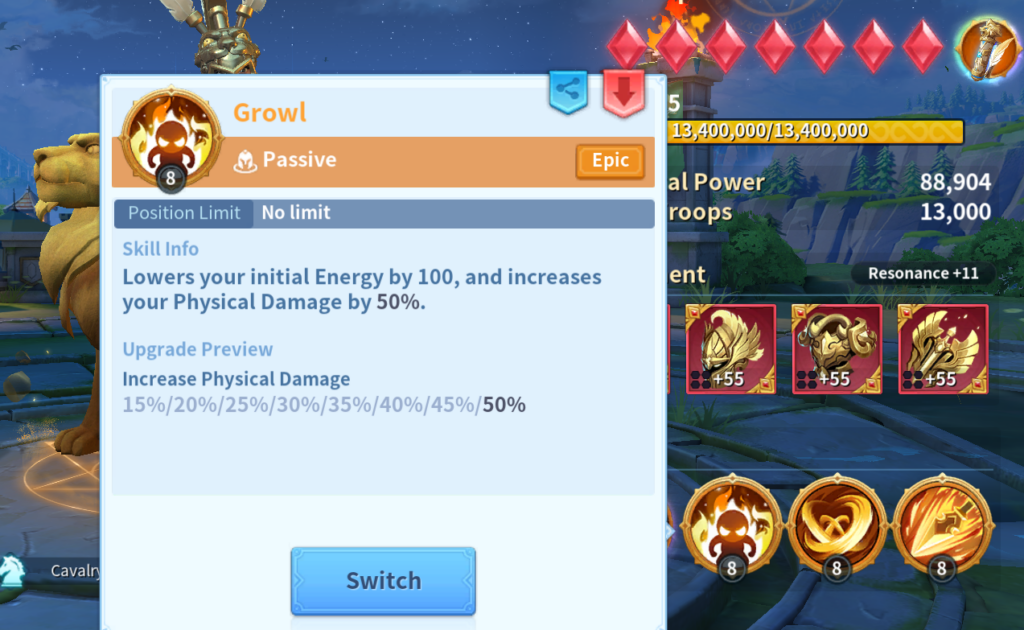
It does not generate additional hits, nor does it improve the likelihood of triggering effects like Wind-rage or Assembly Charge, its value is tied entirely to amplifying all physical damage dealt. Pure and simple. Why it fits nicely here is down to the energy penalty, which is completely removed on Alexander and Hannibal since their unique artifact removes energy entirely from them making their skill a passive.
Performance by Game Mode
PvE Performance (Elemental Domain, Bosses, Spiders)
Growl performs most consistently in PvE environments, where fights tend to be longer and less dependent on early burst timing. In these scenarios, the delayed ultimate has relatively little impact, while the 50% damage increase applies across the entire duration of the fight.
From testing, the improvement is steady rather than explosive. For example, Hippolyta’s damage in Elemental Domain increased by roughly 5–10 million per run after switching to Growl, pushing totals from around 95 million to over 100 million. The rotation itself did not change—what changed was the value of every damage instance within that rotation.
This is where Growl finds its niche. PvE encounters reward sustained output and consistency, and Growl enhances both without requiring specific timing or conditions. It is particularly effective on Immortals with multi-hit abilities, where each individual hit benefits from the scaling.
PvP Performance (Arena, KvK Combat)
In PvP, Growl becomes more situational. The same damage increase is present, but the context is different. Fights are often decided quickly, and early ultimate timing plays a much larger role in determining the outcome.
The energy penalty can delay key abilities just enough to lose early pressure, especially in optimized teams built around fast activation and chaining effects. At the same time, Growl does not contribute to increasing attack frequency or trigger consistency, which are often the main drivers of damage in competitive builds.
Testing reflects this tradeoff. On Alexander, for instance, Growl produced similar or slightly higher damage numbers in some cases, but not by a meaningful margin. Replacing core synergy skills like Assembly Charge typically resulted in minimal gains or even slight losses, because the build depends more on generating additional triggers than amplifying individual hits.
That said, Growl is not unusable in PvP. It fits reasonably well into second or third marches, where optimization is less strict and sustained damage can still provide value. It can also perform adequately in slower matchups where fights extend beyond the initial burst window.
Conclusion Summary
Growl is a situational scaling skill with clear strengths and limitations:
- Provides a 50% physical damage increase across all sources
- Trades early tempo for long-term output via an energy penalty
- Excels in PvE and sustained damage scenarios
- Struggles in fast-paced PvP builds dependent on triggers and timing
Best used:
- In second or third teams
- In PvE content like Elemental Domain and boss fights
- On Immortals with multi-hit or scaling abilities
Final takeaway:
Growl is not a core engine skill—it is a multiplier. If your build already produces consistent damage, Growl will elevate it. If your build depends on speed, chaining, or early pressure, the skill will feel out of place.
Published: 11-04-2026
-

Chapter 6 – Under the Gilded Floor
Infinity Kingdom’s official Lore Series continues with Chapter 6, Under the Gilded Floor. After the enormous revelations surrounding Valhalla, the Sanctuary and the creation of a false god, this chapter brings the story back to Brynhild and the Hangover Knight as they follow the conspiracy into a hidden alchemical laboratory. It is a short chapter,…
-
Patch 3.0.0 – Jadwiga, Gilded Club and Ghost Fiesta Arrive
Infinity Kingdom is officially moving into version 3.0.0, bringing a new Earth support Immortal, two limited Halloween outfits, the new Gilded Club event and fresh gameplay for October’s Ghost Fiesta. Jadwiga is the clear combat headline. Her arrival raises an important question for the current Earth and hybrid meta: can she replace Zenobia or Qin…

