


Legion of Frostborne Weather System Guide
Introduction
Weather is one of the more overlooked mechanics in Legion of Frostborne, largely because most players only pay attention to it when a Blizzard appears before a major fight. In reality, the weather system influences several aspects of the season, from gathering efficiency and territory management to Thermal Tower expansion and combat performance.
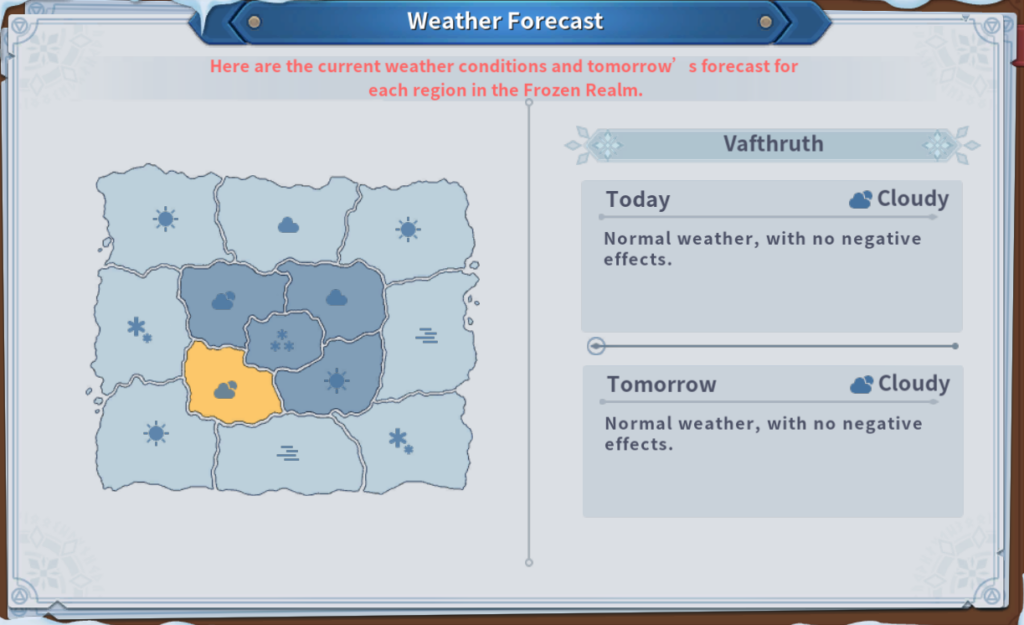
Every province in the Frozen Realm has its own weather conditions, which means two neighboring regions can be experiencing completely different effects at the same time. Fortunately, the game provides both current conditions and a forecast for the following day, giving alliances an opportunity to plan ahead rather than simply reacting when penalties appear.
While weather alone will not decide a season, alliances that consistently use forecasts to guide expansion, gathering, and military operations often gain small advantages that accumulate over time.
Understanding Weather in the Frozen Realm
The weather panel can be accessed directly from the Frozen Realm interface and shows both the current weather and the forecast for the next day in every province.
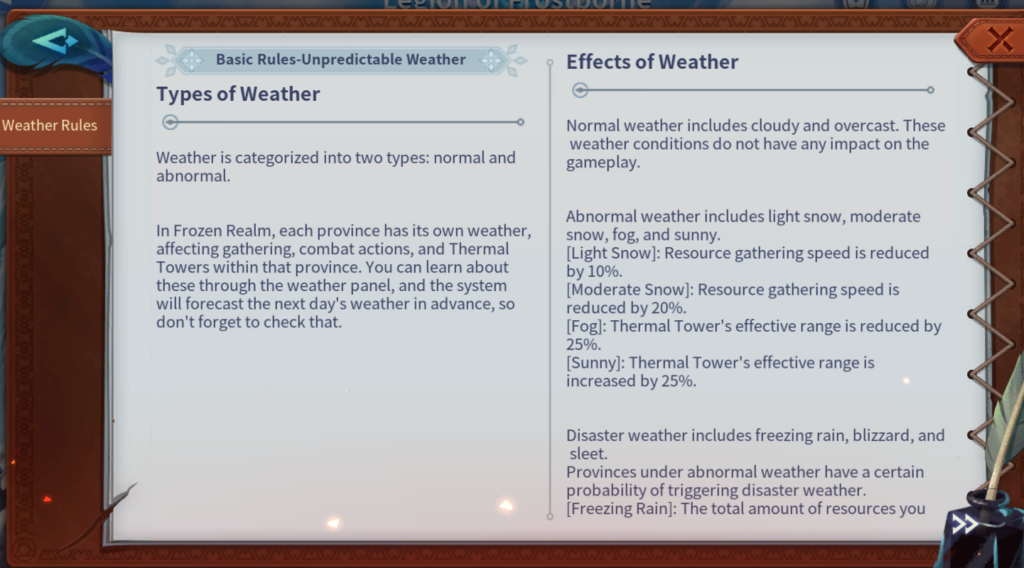
Weather is divided into three categories:
- Normal Weather
- Abnormal Weather
- Disaster Weather
Normal weather has no impact on gameplay and serves primarily as a neutral state. Abnormal weather introduces moderate bonuses or penalties that affect gathering and Thermal Towers, while Disaster Weather creates much stronger effects that can influence alliance strategy on a larger scale.
One important detail is that weather is regional rather than global. A province experiencing favorable conditions may sit directly beside another suffering from severe penalties. Because of this, experienced alliances often monitor weather forecasts when planning expansion routes or scheduling important operations.
Normal Weather
Normal weather includes both Cloudy and Overcast conditions. These weather types do not provide any bonuses or penalties and can generally be ignored from a strategic perspective.
When a province is under normal weather, gathering speeds, combat effectiveness, and Thermal Tower performance all function exactly as expected. Most players consider these conditions the baseline against which all other weather effects are measured.
Abnormal Weather
Abnormal weather introduces manageable but noticeable effects. These conditions rarely force an alliance to change its plans completely, but they can make certain provinces more or less attractive depending on your objectives.
Light Snow
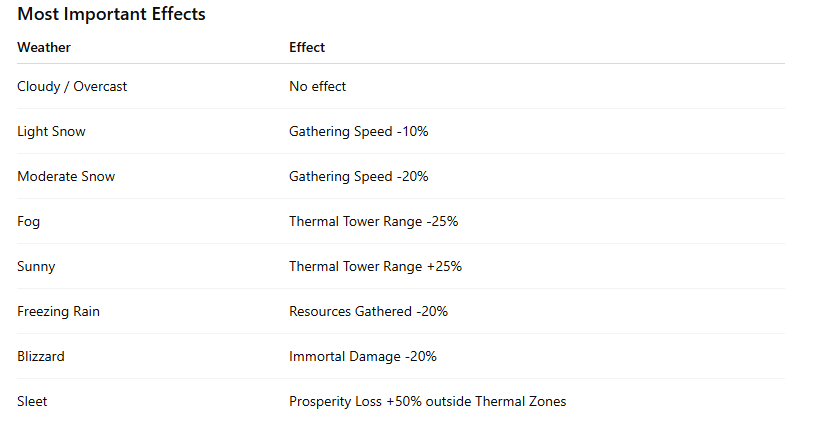
Light Snow reduces resource gathering speed by 10%.
The penalty is relatively minor, and most players will not move gathering marches solely because of Light Snow. However, over the course of a long Frostborne season, even small reductions add up. If multiple gathering locations are available, it often makes sense to prioritize provinces with better weather conditions.
For alliances trying to maximize every bit of resource income, Light Snow is worth paying attention to, even if it is not a major concern.
Moderate Snow
Moderate Snow reduces resource gathering speed by 20%.
At this point the effect becomes much more noticeable. Gathering marches spend significantly longer collecting resources, which can slow development and tower construction if an alliance relies heavily on local gathering.
In several Frostborne seasons I have seen alliances overlook Moderate Snow and continue gathering as normal, only to realize later that their resource production lagged behind neighboring groups. The penalty is not devastating, but it is large enough to justify relocating gatherers whenever practical.
Fog
Fog reduces the effective range of Thermal Towers by 25%.
This is one of the most strategically important weather effects in the entire system.
Thermal Towers determine how efficiently an alliance can expand across the map. Losing a quarter of their range can create unexpected gaps between territories, increase the number of towers required to reach objectives, and complicate carefully planned expansion routes.
Fog becomes particularly problematic near choke points or when pushing toward important strategic targets. A route that appears viable under normal conditions may suddenly require additional towers and resources to maintain.
Sunny
Sunny weather increases Thermal Tower range by 25%.
If Fog is the most frustrating weather condition for expansion, Sunny is arguably the most useful.
The additional range allows alliances to cover more territory with fewer towers, making expansion faster and more resource-efficient. In some situations, Sunny weather can even open routes that would otherwise be impractical.
Whenever I have been involved in alliance leadership during Frostborne, Sunny forecasts were often treated as opportunities. Expansion projects that might normally require extensive tower chains suddenly became much easier to execute.
Disaster Weather
Disaster Weather represents the most severe category of weather effects. These events can have a direct impact on gathering, combat, and territorial stability.
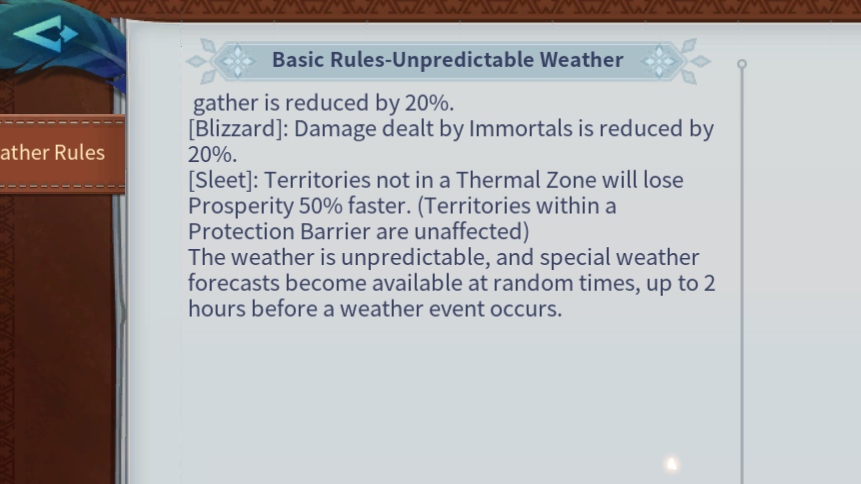
According to the in-game rules, provinces experiencing abnormal weather have a chance to develop into disaster weather conditions. While forecasts provide some warning, these events are designed to be less predictable than standard weather changes.
Freezing Rain
Freezing Rain reduces the total amount of resources gathered by 20%.
Unlike snow, which slows gathering speed, Freezing Rain directly reduces gathering output. Even if a march completes its gathering cycle normally, the final amount collected is reduced.
For players focused on maximizing resources, this is generally one of the least desirable conditions in which to gather.
Blizzard
Blizzard reduces damage dealt by Immortals by 20%.
This weather has a direct impact on combat and can dramatically alter battle outcomes.
Because Immortals account for the majority of damage in most engagements, a 20% reduction is substantial. Battles tend to last longer, offensive momentum slows, and the value of defensive positions increases.
In practice, Blizzard is one of the few weather conditions that alliance leaders regularly consider when planning major attacks. Launching an offensive into a province under Blizzard conditions often produces very different results than the same battle fought under normal weather.
Sleet
Sleet causes territories outside a Thermal Zone to lose Prosperity 50% faster. Territories protected by a Protection Barrier are not affected.
This weather is less visible than Blizzard but can be extremely disruptive for alliances with large or fragmented territory networks.
Remote provinces become harder to maintain, disconnected territory loses value more quickly, and weak expansion routes become increasingly vulnerable. Alliances with strong Thermal Tower coverage are generally able to manage Sleet without major issues, while alliances stretched across the map often feel the effects much more heavily.
Using Weather Forecasts Effectively
Many players treat the forecast window as informational rather than strategic, but the strongest Frostborne alliances usually do the opposite.
Before sending gathering marches, it is worth checking whether nearby provinces are affected by snow or Freezing Rain. Before beginning a major expansion project, look at the forecast for Fog or Sunny weather. Before launching large-scale military operations, check whether Blizzard conditions could reduce combat effectiveness.
None of these decisions will win a season by themselves, but Frostborne is often decided by dozens of small advantages rather than a single decisive factor.
The alliances that consistently pay attention to weather are usually the same alliances that waste fewer resources, expand more efficiently, and avoid fighting battles under unfavorable conditions.
Final Thoughts
The Weather System adds another layer of strategy to Legion of Frostborne by forcing players to adapt to changing regional conditions throughout the season.
Most weather effects are manageable, but a few deserve special attention. Sunny and Fog can significantly influence Thermal Tower expansion, while Blizzard can directly affect combat performance during critical battles. Meanwhile, Freezing Rain and snow conditions primarily impact resource efficiency and long-term development.
Published: 05-06-2026
-

Chapter 6 – Under the Gilded Floor
Infinity Kingdom’s official Lore Series continues with Chapter 6, Under the Gilded Floor. After the enormous revelations surrounding Valhalla, the Sanctuary and the creation of a false god, this chapter brings the story back to Brynhild and the Hangover Knight as they follow the conspiracy into a hidden alchemical laboratory. It is a short chapter,…
-
Patch 3.0.0 – Jadwiga, Gilded Club and Ghost Fiesta Arrive
Infinity Kingdom is officially moving into version 3.0.0, bringing a new Earth support Immortal, two limited Halloween outfits, the new Gilded Club event and fresh gameplay for October’s Ghost Fiesta. Jadwiga is the clear combat headline. Her arrival raises an important question for the current Earth and hybrid meta: can she replace Zenobia or Qin…

